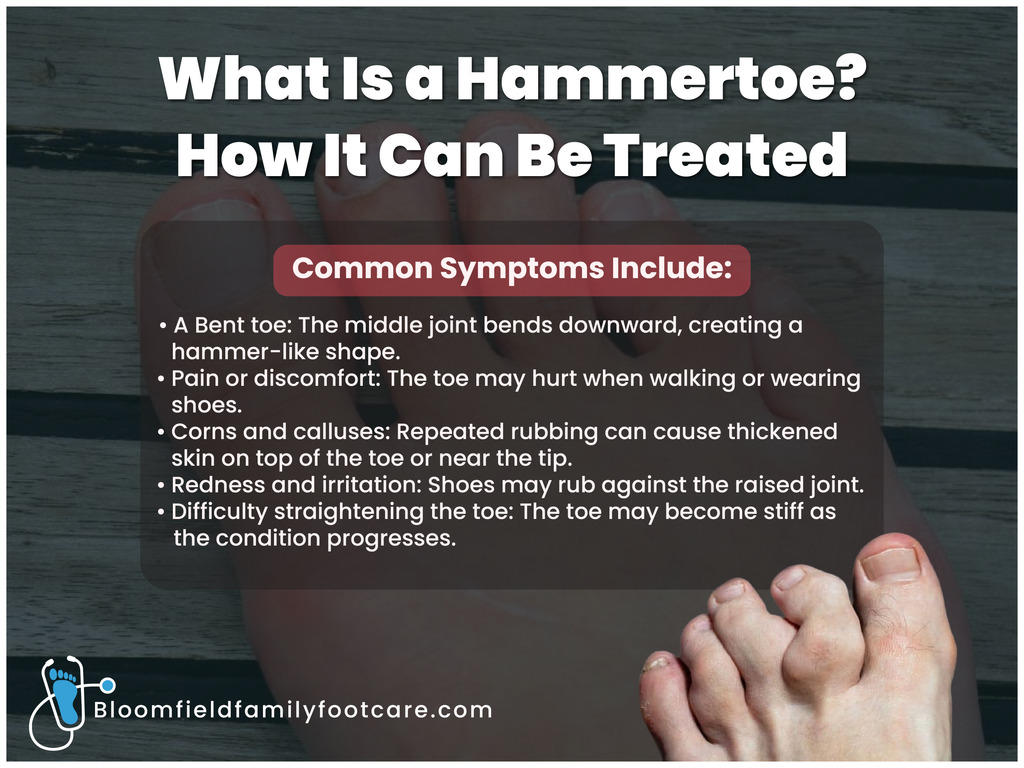
Have you noticed that one of your toes is starting to bend downward instead of staying straight? You may have a condition called a hammertoe. It happens when the muscles, tendons, or joints in a toe become unbalanced, causing the middle joint to bend. Hammertoes most often affect the second, third, or fourth toes. At first, the toe may still be flexible, but over time, it can become stiff and harder to straighten. The condition may seem small, but it can make walking and wearing shoes uncomfortable.
What Causes a Hammertoe?
Hammertoes can develop for several reasons. Wearing tight shoes, narrow toe boxes, or high heels may crowd the toes and increase pressure. Some people are also more likely to develop hammertoes because of foot structure, muscle imbalance, arthritis, or previous toe injuries. In some cases, a hammertoe develops alongside a bunion.
Common signs to watch for include:
- A bent toe: The middle joint bends downward, creating a hammer-like shape.
- Pain or discomfort: The toe may hurt when walking or wearing shoes.
- Corns and calluses: Repeated rubbing can cause thickened skin on top of the toe or near the tip.
- Redness and irritation: Shoes may rub against the raised joint.
- Difficulty straightening the toe: The toe may become stiff as the condition progresses.
How Can Hammertoes Be Treated?
Treatment depends on how flexible the toe is and how much discomfort it causes. If the hammertoe is still flexible, changing to shoes with a wide toe box, using protective padding, and trying appropriate toe exercises may help improve comfort. A podiatrist may also recommend custom orthotics to help manage pressure and improve how your foot functions. These options can relieve symptoms, but they may not permanently straighten the toe.
If the toe becomes rigid, painful, or difficult to fit into shoes, additional treatment may be needed. In more severe cases, surgery may be discussed to correct the toe’s position. A podiatrist can examine your foot, determine the severity of the condition, and explain which options are appropriate for you.
For residents of Bloomfield Hills and nearby Michigan communities, Bloomfield Family Footcare can evaluate toe pain, hammertoes, and other foot concerns. Getting an early assessment may help you manage discomfort before it begins affecting your everyday activities.
Quick FAQs
1. Can a hammertoe go away on its own?
A hammertoe usually does not correct itself. However, early treatment and proper footwear may help reduce discomfort and prevent irritation.
2. Are hammertoes caused by wearing tight shoes?
Tight or narrow shoes can contribute to hammertoes by squeezing the toes and increasing pressure. Foot structure, muscle imbalance, and arthritis can also play a role.
3. When should I see a podiatrist for a hammertoe?
Schedule an evaluation if your toe becomes painful, stiff, irritated, or difficult to fit into shoes. Early care can help you understand your treatment options.
Contact Information & Services
Bloomfield Family Footcare – Bloomfield Hills
10 West Square Lake, Suite 300
Bloomfield Hills, MI 48302
📞 Phone: (248) 333-4900
Bloomfield Family Footcare – Dearborn
2035 Monroe St
Dearborn, MI 48124
📞 Phone: (313) 253-0600
SERVICES
https://bloomfieldfamilyfootcare.com/services/
SOCIAL MEDIA
FACEBOOK & INSTAGRAM